Cuidado de la piel avanzado para aumentar la resiliencia de tu piel a través del poder de ingredientes activos basados en plantas con innovación cosmética botánica.

El lado obscuro de tu perfume, la asociación con cáncer de mama y desbalances hormonales
Y que hacer para minimizar el riesgo sin dejar de perfumar tu cuerpo
32
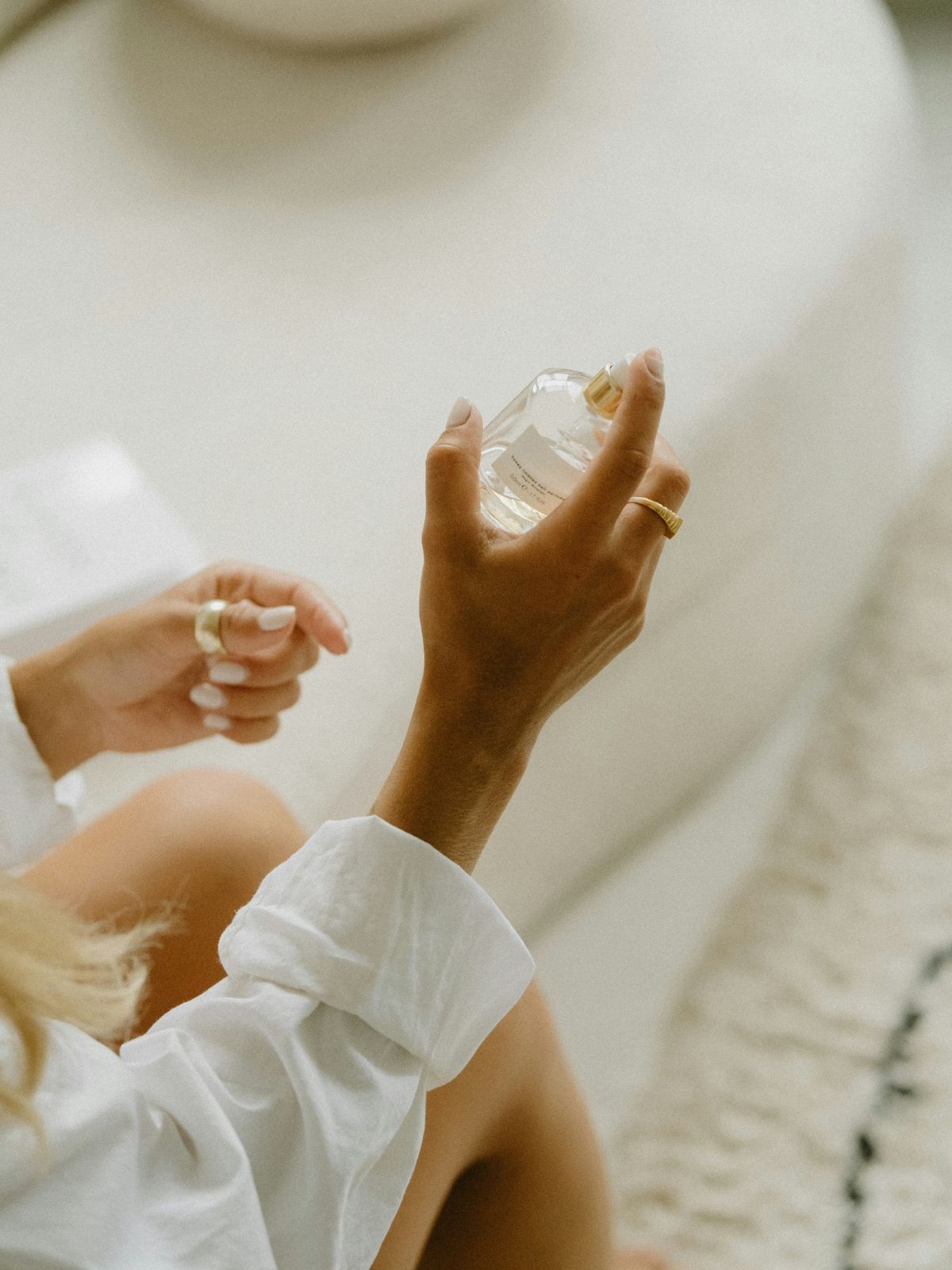
El punto débil de muchas de nosotras son los perfumes que duran todo el día, que impregnan la ropa, la cama y damos preferencia a un producto para usar en la piel, cabello y cuerpo dependiendo de que tan duradero es su aroma, nos encanta comprar velas, perfumes ambientales, sprays para oler rico, limpiadores que dejen la casa perfumada el mayor tiempo posible.
Hoy hay un mercado infinito de fragancias, perfumes, aromatizantes ambientales, velas. Pero la mayoría de ellas tienen ftalatos y es de lo que me gustaría hablarte en este artículo.
Los ftalatos o ésteres de ácido ftálico son un grupo de productos químicos industriales utilizados para la fabricación de plástico, para hacerlo más flexible o resistente, pero también se utilizan para extender la duración de los perfumes, lociones, cremas, sueros, velas, body sprays, limpiadores de tu casa, detergente de ropa, suavizante y en la mayoría de productos plásticos para el hogar, en skincare y cuidado del cuerpo su uso es sumamente común y normalmente lo usan para disfrazar el aroma neutro de los ingredientes utilizados.
Se usan en muchísimas marcas, aún en las que se promocionan como naturales, limpias, libres de sulfatos, clean beauty.
Se usan en alta cantidad en las velas que nos encanta prender, aromatizantes de ambiente, fragancias para el ambiente, jabón de ropa, cuerpo, shampoos, limpiadores del hogar, suavizantes de telas y casi en todo lo que encontrarás con aroma que no sea botánico.
El problema en sí no es el producto, es que usamos constantemente decenas de ellos diariamente y su uso es acumulable en la sangre y órganos.
Los sintéticos que se usan normalmente no son puras ni con estándares de calidad elevados y generalmente no incluyen la hoja de seguridad, el casi 100% de todo lo que usas perfumado incluyen ftalatos disfrazados en el ingrediente PERFUME y no se indica en la materia prima como tal.
Es por eso que tu ropa tiene un olor “fresco” durante semanas después de haberla sacado de la secadora, el aroma de tu shampoo, spray, productos de estilizado que dura todo el día en tu cabello y ese perfume que se vende como natural pero te dura todo el día y aún en días siguientes sigue estando penetrado en tu ropa.
Los ftalatos mantienen los aromas y perfumes por mucho tiempo a diferencia de la aromática sin ftalatos.
Lo importante es que sepas que la exposición a los ftalatos presenta riesgos. Más aún si los usamos constantemente en artículos de limpieza, detergentes de ropa, suavizantes, skincare, perfumería, aromatizantes de casa como velas, atomizadores, inciensos, infinidad de veces al día, constantemente.
Según decenas de estudios clínicos (no es por opinión personal) se han relacionado con una serie de problemas de salud que incluyen asma, trastorno por déficit de atención con hiperactividad, cáncer de mama, obesidad, diabetes tipo 2, bajo coeficiente intelectual, problemas de desarrollo neurológico, problemas de comportamiento, trastornos del espectro autista, desarrollo reproductivo alterado, desbalance hormonal y problemas de fertilidad masculina. En la UE son parte de la lista de los ingredientes restringidos que aún hoy se siguen usando en toda América.
En la parte inferior dejaremos la lista completa con referencias.
En nuestra marca somos libres de ftalatos, podrás estar seguro de que en cada uno de nuestros productos no los encontrarás, y que al usar nuestras velas aromáticas, perfumería, skincare, bodycare, haircare, makeup es zona segura libre de ftalatos para ti y para tu familia.
Dónde encontrar cosmética sin ftalatos da click
REFERENCIAS:
[1] European Chemicals Agency (ECHA). Dibutyl phthalates. Available online: https://echa.europa.eu/documents/10162/13641/dbp_echa_review_report_2010_6_en.pdf August 13, 2014.
[2] European Chemicals Agency (ECHA). Bis(2-ethylhexyl) phthalate. Available online: https://echa.europa.eu/substance-information/-/substanceinfo/100.003.829 August 13, 2014.
[3] European Chemicals Agency (ECHA). Dibutyl phthalates. Available online: https://echa.europa.eu/documents/10162/13641/dbp_echa_review_report_2010_6_en.pdf August 13, 2014.
[4] Byrdie.14 ‘5 free’ nail polish brands. Available online: https://www.byrdie.com/free-nail-polish-14-brands-worth-your-money-346730 August 14, 2014.
[5] Malkan, S. Not Just a Pretty Face: The Ugly Side of the Beauty Industry. Gabriola, BC, Canada: New Society Publishers, pp. 18-19. 2007.
[6] Houlihan J, Brody C, Schwan B (2002). Not Too Pretty: Phthalates, Beauty Products and the FDA. Available online: https://static.ewg.org/reports/2002/NotTooPretty.pdf?_ga=2.79541012.1878150350.1597799880-1583975922.1597799880 August 18, 2014.
[7] Archer L, Brody C, Malkan S, Sarantis H (2008). A Little Prettier. Available online: http://www.safecosmetics.org/wp-content/uploads/2015/02/A-Little-Prettier.pdf August 18, 2014.
[8] Manori JS, et al., Urinary levels of seven phthalate metabolites in a human reference population. Environmental Health Perspectives, vol. 112, no. 3, pp 331-338, 2002. Available online: http://www.ncbi.nlm.nih.gov/pmc/articles/PMC1241863/pdf/ehp0112-000331.pdf August 14, 2014.
[9] Manori JS, et al., Urinary levels of seven phthalate metabolites in a human reference population. Environmental Health Perspectives, vol. 112, no. 3, pp 331-338, 2002. Available online: http://www.ncbi.nlm.nih.gov/pmc/articles/PMC1241863/pdf/ehp0112-000331.pdf August 14, 2014.
[10] Centers for Disease Control and Prevention (CDC). Fourth national report on human exposure to environmental chemicals, 2013. https://www.cdc.gov/exposurereport/pdf/FourthReport_UpdatedTables_Sep2013.pdf August 14, 2014.
[11] European Commission. List of 146 substances with endocrine disruption classifications prepared in the espert meeting. Available online: http://ec.europa.eu/environment/archives/docum/pdf/bkh_annex_13.pdf August 13, 2014.
[12] The Endocrine Disruption Exchange (TEDX). Diethyl phthalate. Available online: http://endocrinedisruption.org/popup-chemical-details?chemid=527 August 13, 2014.
[13]The Endocrine Disruption Exchange (TEDX). Di(2-ethylhexyl) phthalate. Available online: http://endocrinedisruption.org/popup-chemical-details?chemid=505 August 13, 2014.
[14] The Endocrine Disruption Exchange (TEDX). Dibutyl phthalate. Available online: http://endocrinedisruption.org/popup-chemical-details?chemid=510 August 13, 2014.
[15] Swan SH, et al., Decrease in Anogenital Distance among Male Infants with Prenatal Phthalate Exposure. Environmental Health Perspectives, vol. 113, pp 1056-1061, 2005. Available online: http://www.ncbi.nlm.nih.gov/pmc/articles/PMC1280349/pdf/ehp0113-001056.pdf. August 18, 2014.
[16] Breast Cancer Prevention Partners Glossary of Exposures: https://www.bcpp.org/resource/phthalates/
[17] Swan SH, et al., Decrease in Anogenital Distance among Male Infants with Prenatal Phthalate Exposure. Environmental Health Perspectives, vol. 113, pp 1056-1061, 2005. Available online: http://www.ncbi.nlm.nih.gov/pmc/articles/PMC1280349/pdf/ehp0113-001056.pdf. August 18, 2014
[18] Main KM, et al., Human breast milk contamination with phthalates and alterations of endogenous reproductive hormones in infants three months of age. Environmental Health Perspectives, vol. 114, pp 270-276, 2006. Available online: http://www.ncbi.nlm.nih.gov/pmc/articles/PMC1367843/pdf/ehp0114-000270.pdf. August 18, 2014.
[19]European Chemicals Agency (ECHA). Candidate list of substances of very high concern for authorization: DEHP. Available online: http://echa.europa.eu/web/guest/candidate-list-table August 13, 2014.
[20]European Chemicals Agency (ECHA). Candidate list of substances of very high concern for authorization: DBP. Available online: http://echa.europa.eu/web/guest/candidate-list-table August 13, 2014.
[21] Hauser R, et al., DNA damage in human sperm is related to urinary levels of phthalate monoester and oxidative metabolites. Human Reproduction, vol. 22, pp 688-695, 2007. Available online: http://humrep.oxfordjournals.org/content/22/3/688.full.pdf+html. August 18, 2014.
[22] Jurewicz J. & Hanke W., Exposure to phthalates: reproductive outcome and children health. A review of epidemiological studies. International Journal of Occupational Medicine and Environmental Health, vol. 24, no. 2, pp 115-41, 2011. Available online: http://www.ncbi.nlm.nih.gov/pubmed/21594692 August 14, 2014.
[23] Kamrin MA., Phthalate risks, phthalate regulation, and public health: a review. Journal of Toxicology and Environmental Health, Part B: Critical Reviews, vol. 12, pp 157-74, 2009. Abstract online: http://www.ncbi.nlm.nih.gov/pubmed/19235623. August 18, 2014.
[24] Pant N., et al., Environmental and experimental exposure of phthalate esters: The toxicological consequence on human sperm. Human and Experimental Toxicology, vol. 30, no. 6, pp 507-14, 2010. Abstract Available Online: http://www.ncbi.nlm.nih.gov/pubmed/20551087. August 18, 2014.
[25] Swan SH, et al., Decrease in Anogenital Distance among Male Infants with Prenatal Phthalate Exposure. Environmental Health Perspectives, vol. 113, pp 1056-1061, 2005. Available online: https://www.ncbi.nlm.nih.gov/pmc/articles/PMC1280349/. July 24, 2008.
[26] Main KM, et al., Human breast milk contamination with phthalates and alterations of endogenous reproductive hormones in infants three months of age. Environmental Health Perspectives, vol. 114, pp 270-276, 2006. Available online: http://www.ncbi.nlm.nih.gov/pmc/articles/PMC1367843/pdf/ehp0114-000270.pdf. August 18, 2014.
[27] Swan SH., Environmental phthalate exposure in relation to reproductive outcomes and other health endpoints in human. Environmental Research, vol. 108, pp 177-84, 2008. Available online: http://www.ncbi.nlm.nih.gov/pmc/articles/PMC1280349/pdf/ehp0113-001056.pdf. August 18, 2014.
[28] Gray LE, et al., Chronic di-n-butyl phthalate exposure in rats reduces fertility and alters ovarian function during pregnancy in female Long Evans hooded rats. Toxicological Science, vol. 93, no. 1, pp 189-95, 2006. Available online: http://toxsci.oxfordjournals.org/content/93/1/189.full.pdf+html. August 18, 2014.
[29] Gray LE, et al., Chronic di-n-butyl phthalate exposure in reats reduces fertility and alters ovarian function during pregnancy in female Long Evans hooded rats. Toxicological Science, vol. 93, no. 1, pp 189-95, 2006. Available online: http://toxsci.oxfordjournals.org/content/93/1/189.full.pdf+html. August 18, 2014.
[30] Tranfo G., et al., Urinary phthalate monoesters concentration in couples with infertility problems. Toxicology Letters, vol. 213, pp 15-20, 2012. Abstract Available online: http://www.ncbi.nlm.nih.gov/pubmed/22197707. August 18, 2014.
[31] Jurewicz J. & Hanke W., Exposure to phthalates: reproductive outcome and children health. A review of epidemiological studies. International Journal of Occupational Medicine and Environmental Health, vol. 24, no. 2, pp 115-41, 2011. Available online: http://www.ncbi.nlm.nih.gov/pubmed/21594692 August 14, 2014.
[32] Borch J, et al., Mechanisms underlying the anti-androgenic effects of diethylhelxyl phthalate in fetal rat testis. Toxicology, vol. 223, pp 144-155, 2006. Abstract Available online: http://www.ncbi.nlm.nih.gov/pubmed/16690193. August 18, 2014.
[33] Kang SC. & Lee BM., DNA methylation of estrogen receptor alpha gene by phthalates. Journal of Toxicology and Environmental Health Part A, vol. 68, pp 1995-2003, 2005. Abstract Available online: http://www.ncbi.nlm.nih.gov/pubmed/16326419. August 18, 2014.
[34] National Toxicology Program. Reports on Carcinogens, twelfth edition, 2011: Di(2-ethylhexyl) phthalate Available online: http://ntp.niehs.nih.gov/ntp/roc/twelfth/roc12.pdf August 13, 2014.
[35] U.S. Environmental Protection Agency. IRIS: Di(e-ethylhexyl) phthalate (DEHP). Available online: https://cfpub.epa.gov/ncea/iris2/chemicalLanding.cfm?substance_nmbr=14. August 13, 2014.
[36] Kim IY, Han SY, Moon A. Phthalates inhibit tamoxifen-induced apoptosis in MCF-7 human breast cancer cells. Journal of Toxicology and Environmental Health, vol. 67, pp 2025-2035, 2004. Abstract Available online: http://www.ncbi.nlm.nih.gov/pubmed/15513900. August 18, 2014.
[37] Alam MS., et al., Induction of spermatogenic cell apoptosis in prepubertal rat testes irrespective of testicular steroidogenesis: a possible estrogenic effect of di(n-butyl) phthalate. Society of Reproduction and Fertility, vol. 139, pp 427-37, 2010. Available online: http://www.reproduction-online.org/content/139/2/427.full.pdf+html. August 18, 2014.
[38] Jobling S, Reynolds T, White R, Parker MG, Sumpter JP (1995). A variety of environmentally persistent chemicals, including some phthalate plasticizers, are weakly estrogenic. Environmental Health Perspectives 103(6):582-7. Available online: http://www.ncbi.nlm.nih.gov/pmc/articles/PMC1519124/pdf/envhper00355-0058.pdf. August 18, 2014.
[39] Chen FP. & Chien MH., Lower concentrations of phthalates induce proliferation in human breast cancer cells. Climacteric, vol. 17, no. 4, pp 377-84, 2014. https://pubmed.ncbi.nlm.nih.gov/24228746/
[40] Centers for Disease Control and Prevention. NIOSH pocket guide to chemical hazards: naphtha (coal tar). Available online: https://www.cdc.gov/niosh/npg/npgd0438.html. 2014.